
By Tim Baldwin
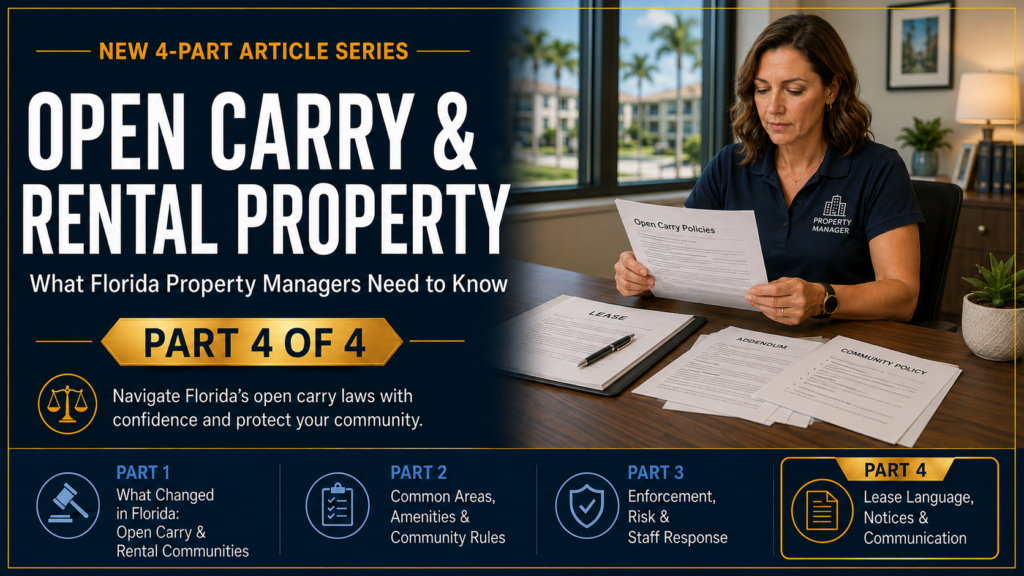
This article is the final installment in a four-part series from Property Management Law Solutions, PLLC examining Florida’s changing open carry landscape and what it may mean for landlords, property managers, and rental communities.
A community decides it wants to update its firearm policy. The lease contains an old “no weapons” clause. The amenity rules say nothing about firearms. A sign at the leasing office uses different language. Current residents never signed an addendum, and staff members are unsure which rule they can enforce.
So what happens when those documents do not match?
A policy problem can quickly become an enforcement problem.
In Part 1, we examined what changed in Florida and why property managers should be cautious before adopting broad firearm restrictions. In Part 2, we focused on common areas, amenities, and community rules. In Part 3, we discussed enforcement, risk, documentation, and staff response.
The final step is implementation.
How should a rental community put its firearm policy into writing and communicate it to residents?
Understanding the legal and operational issues is only part of the process. The lease, community rules, amenity policies, resident notices, signage, staff procedures, and enforcement forms should support the same policy. When those materials conflict, even a reasonable policy may become difficult to explain, apply, or defend.
A Policy Is Only as Strong as the Documents Behind It
A firearm policy should not exist as a sentence copied into one document without considering the rest of the community’s lease enforcement system.
The lease may establish the resident’s core obligations. Community rules may address shared spaces. Amenity policies may apply to the pool, clubhouse, or fitness center. Signage may reinforce the rule at a specific location. Staff procedures may explain how employees should respond. Violation notices may identify the provision management intends to enforce.
Each document has a different job, but all of them should tell the same story.
“The strongest policy is not necessarily the longest or the strictest,” said Tim Baldwin, founder and managing attorney of Property Management Law Solutions, PLLC. “It is the policy that residents can understand, staff can apply consistently, and management can support with clear documents and proof of notice.”
Start With the Conduct the Community Wants to Address
Before drafting language, property managers should identify the actual concern.
Is the community trying to address unsafe handling, threatening behavior, firearm discharge, intimidation, guest conduct, firearms in a specific amenity, or interactions inside the leasing office?
A broad rule against “weapons” may sound simple, but it may not explain what conduct is prohibited, where the rule applies, who must follow it, or what happens when it is violated.
A more useful drafting process begins with a few practical questions:
- What conduct is the community trying to prevent?
- Where does the rule apply?
- Does it apply to residents, guests, vendors, employees, or other visitors?
- Which lease provision or community rule supports enforcement?
- What notice will residents receive?
- What consequence may follow a violation?
Clear answers to those questions help the community draft language that is specific, understandable, and connected to an actual safety or operational concern.
Give Each Document a Clear Role
Not every community needs a separate document for every issue. However, property managers should understand which document controls each part of the policy.
- The lease should contain the core resident obligations, guest responsibility provisions, and remedies the community may rely on.
- An addendum may provide more detailed firearm provisions when the lease does not contain enough space or detail.
- Community rules may address conduct in shared spaces throughout the property.
- Amenity rules may address specific locations such as pools, clubhouses, fitness centers, playgrounds, and community events.
- Resident notices should explain a new policy, a policy reminder, an effective date, or a change in procedure.
- Signage should reinforce an existing rule at the location where it applies.
- Staff procedures should explain internal reporting, escalation, documentation, and approval requirements.
- Incident reports and violation notice templates should support the enforcement process.
Signage is important, but a sign, by itself, should not attempt to create a rule that does not appear in the lease or community documents. Signage that is supported by lease and community documents have stronger legal effect. A resident notice should not promise enforcement that the lease does not support. An internal staff procedure should not conflict with what residents were told.
The documents should work together instead of competing with one another.
Review Existing Language for Conflicts
Court rulings that affect firearm possession and carry have expanded recently, so it’s likely that many communities do not have language addressing firearms, weapons, dangerous items, threats, disturbances, criminal activity, or resident safety. Incorporating proper lease and community policy language is important and needed now more than ever.
The first step is not always adding new language to existing provisions. Instead, it may be identifying conflicts in the language that already exist.
For example, the lease may prohibit all weapons anywhere on the property, while the pool rules address only unsafe conduct and the leasing office sign says firearms are prohibited inside the office. Those provisions may reflect different intentions, but residents and staff may not know which rule controls.
Property managers should compare the terminology, locations, people covered, prohibited conduct, and potential consequences across all related documents.
The community should also decide whether terms such as “weapon,” “firearm,” “dangerous item,” “open carry,” and “unsafe handling” are being used consistently. Undefined or inconsistent terms can create uncertainty when enforcement becomes necessary.
New Residents, Renewing Residents, and Current Residents May Require Different Approaches
It is generally easier to introduce policy language before a resident signs a lease.
New residents can receive the lease, addenda, community rules, and amenity policies before move-in. The community can require signatures or electronic acknowledgments and retain proof that the documents were delivered.
Renewal provides another opportunity to update language. Revised provisions can be included with the renewal documents and acknowledged before the new lease term begins.
Current residents may present a more complicated issue. Some leases allow management to adopt reasonable rule changes during the lease term, but many courts limit a landlord’s ability to impose material changes to the tenant’s obligations during their lease term. Other leases may limit when and how new restrictions can take effect. A safety reminder may be different from a new enforceable lease obligation.
Property managers should review the existing lease before assuming that a new firearm policy can be imposed immediately. Some changes may require advance notice, resident agreement, or implementation at renewal. Legal review is especially important when a proposed rule changes what residents may do inside their units or imposes a new basis for lease enforcement.
Resident Notices Should Explain the Policy Clearly
Firearm issues can become emotional and political. Resident communication should remain calm, factual, and focused on community operations.
A notice should explain why the community is communicating, where the policy applies, when it takes effect, who must follow it, what conduct is expected, and where residents can review the full policy.
Management should avoid broad statements that the documents do not support. A notice should not say that all firearms are prohibited everywhere if the actual policy applies only to certain common areas or types of conduct.
The notice should also avoid debating constitutional rights or attempting to explain criminal law. The purpose is to communicate the community’s policy, not to resolve every legal question a resident may raise.
Signage Should Reinforce the Governing Documents
Signs can help communicate expectations in leasing offices, clubhouses, fitness centers, pools, and other shared spaces. However, signage should reinforce a written policy rather than serve as the only source of the rule.
The wording on the sign should match the lease, addendum, community rules, or amenity policy. The location of the sign should also make sense for the area being regulated.
A leasing office sign may address a different concern than a pool rule or a notice for a community event. While posting signage is important, property managers should avoid using one broad sign as a substitute for a carefully reviewed policy.
Proof of Delivery Matters
A community may draft a clear policy and still face difficulty enforcing it if management cannot show that the resident received it.
Property managers should maintain reliable records of policy delivery and acknowledgment. Depending on the community’s process, that may include:
- Signed lease addenda.
- Electronic acknowledgments.
- Move-in packet records.
- Renewal documents.
- Resident portal confirmations.
- Email delivery records.
- Copies of notices and effective dates.
- Archived versions of prior policies.
If a dispute occurs, the community should be able to identify which version of the policy applied, when the resident received it, and how receipt was documented.
Documentation completed during implementation may become important evidence during enforcement.
Build the Enforcement Documents Before the First Violation
The policy rollout should include a review of the documents staff will use if a violation occurs.
The community should identify the lease provision or rule that may support enforcement, determine which notice form may apply, and decide who must review or approve the notice before it is issued.
The wording of a violation notice should match the governing document and the documented facts. Management should avoid generic labels such as “firearm violation” when the actual concern involves unsafe handling, threatening conduct, discharge, trespass, or violation of a specific amenity rule.
The policy should not promise automatic eviction or another result that may not be supported by the lease, the facts, or Florida law. The seriousness of a firearm issue makes careful review more important, not less.
Use a Document Alignment Test
Before rolling out a new or revised policy, place the related documents side by side and ask whether they describe the same rule.
- Does the lease support the community rule?
- Does the addendum use the same terms?
- Do the amenity rules identify the correct locations?
- Does the resident notice accurately describe the policy?
- Does the signage match the written documents?
- Do staff procedures reflect what residents were told?
- Do the incident report and violation notice forms capture the information needed for enforcement?
- Can the community prove when each resident received the policy?
If the answers are unclear, the policy may not be ready for implementation.
Practical Implementation Checklist
Before adopting or revising a firearm policy, Florida property managers should consider the following steps:
- Identify the specific safety or operational concern.
- Inventory the lease, addenda, community rules, amenity policies, notices, signs, and staff procedures.
- Define the conduct, locations, and people covered by the policy.
- Remove conflicting or outdated language.
- Confirm which document will control each part of the policy.
- Obtain legal review before rollout.
- Determine when the policy can take effect for new, renewing, and current residents.
- Prepare resident notices and acknowledgment procedures.
- Update signage, move-in materials, renewal documents, and resident portal content.
- Review incident reports and violation notice templates.
- Train staff on the final policy and approval process.
- Retain prior policy versions and proof of delivery.
The Bottom Line
Florida’s changing open carry landscape does not require every rental community to adopt the same firearm policy.
It does give every community a reason to review the documents it already relies on.
A policy should identify the actual concern, apply to the appropriate locations, use consistent language, and fit within the community’s lease enforcement process. Residents should receive clear notice. Staff should understand which documents control. Management should be able to prove what was delivered and when.
The goal is not to create the broadest or most complicated policy. The goal is to create a policy that is clear, practical, properly communicated, and supported by the documents the community will rely on if enforcement becomes necessary.
This article concludes our four-part series on open carry and Florida rental communities. The overall lesson is straightforward: understand the legal change, evaluate the space involved, respond to conduct carefully, and make sure the community’s documents work together before a dispute occurs.
If your community is reviewing firearm language, Property Management Law Solutions, PLLC can help compare your lease, rules, notices, signage, and staff procedures before changes are implemented.
Property Management Law Solutions, PLLC is a Florida law firm focused on helping property managers, landlords, and housing providers navigate the legal issues that arise in rental communities. PMLS represents hundreds of clients and communities across Florida and is built to make complex landlord-tenant issues easier to understand, faster to address, and more effective to resolve.
If your team has questions about lease enforcement, community rules, resident notices, amenity policies, or compliance concerns, PMLS can provide practical legal guidance before small issues become larger legal problems.
To schedule a consultation or speak with the PMLS team, call (850) 857-2463 or visit pmlawsolutions.com