
By Tim Baldwin
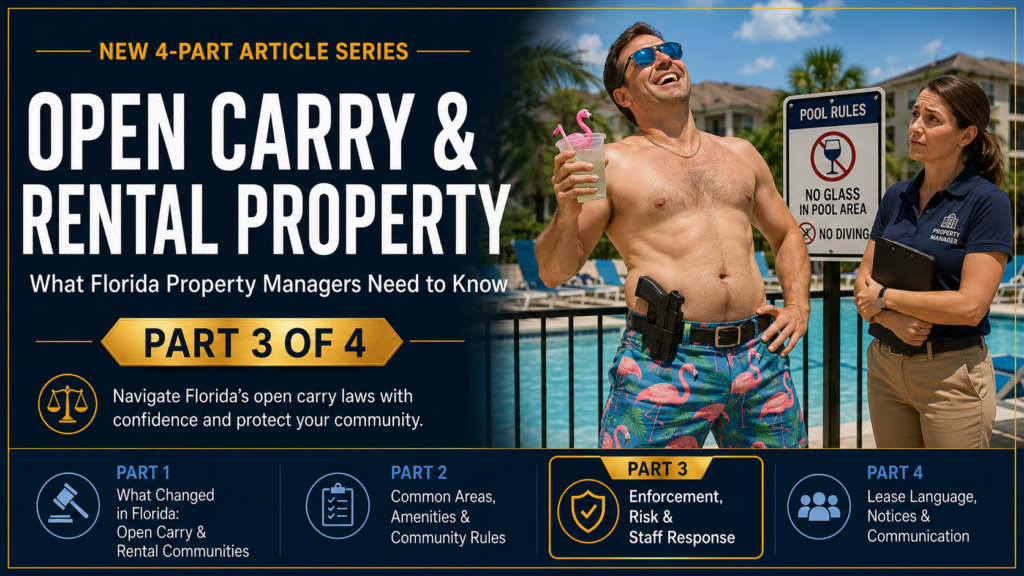
This article is the third in a four-part series from Property Management Law Solutions, PLLC examining Florida’s changing open carry landscape and what it may mean for landlords, property managers, and rental communities.
In Part 1, we looked at what changed in Florida and why property managers should be cautious before adopting broad firearms restrictions. In Part 2, we focused on common areas, amenities, and community rules.
Now we turn to the issue that may matter most in the moment:
What should property staff do when a resident or guest is openly carrying a firearm on the property?
For property managers, this is not only a legal question. It is also an operational, staff-safety, documentation, and potentially emergency-response issue.
Florida’s open carry landscape may have changed, but property managers still need calm, consistent procedures for responding to firearm-related situations.
“Property staff should not be expected to make constitutional law decisions at the leasing desk or in the middle of a resident dispute,” said Tim Baldwin, founder and managing attorney of Property Management Law Solutions, PLLC. “The goal is to keep people safe, document what actually happened, and avoid escalating a situation unnecessarily.”
Open Carry Is Not the Same as Threatening Conduct
One of the most important distinctions for property managers is the difference between lawful open carry and threatening or unsafe conduct.
A resident walking through a parking lot with a holstered firearm presents a different issue than a resident displaying a firearm during an argument with staff.
A guest passing through a common area with a firearm secured on their person is different from someone handling a firearm near the pool, clubhouse, playground, or leasing office.
A firearm that remains holstered is different from one being waved, pointed, handled carelessly, or used to intimidate another person.
Those distinctions matter.
The mere fact that a firearm is visible may not automatically mean the person is violating the law. But open carry does not give anyone permission to threaten others, mishandle a weapon, refuse to leave after being properly directed, violate lawful community rules, or create a dangerous situation.
For property managers, the focus should be on conduct, location, risk, and documentation.
Staff Should Not Be Expected to Make Legal Conclusions
Leasing consultants, maintenance employees, assistant managers, and community managers should not be placed in the position of making complicated legal judgments in real time.
Staff should not be expected to:
- Determine whether a person has a legal right to carry.
- Debate constitutional law with a resident.
- Physically confront or attempt to disarm someone.
- Escalate a situation simply because a firearm is visible.
Instead, staff should follow a clear internal response process designed to protect people, preserve facts, and involve management, law enforcement, or legal counsel when appropriate.
The First Question: Is There an Immediate Safety Threat?
When staff become aware of a firearm-related situation, the first question should be practical:
Is there an immediate threat to staff, residents, guests, vendors, or the public?
Possible warning signs may include:
- Threats or intimidation.
- Pointing or displaying a firearm during a confrontation.
- Unsafe handling in a crowded area.
- Intoxication.
- Domestic conflict or physical fighting.
- Refusal to leave an office or amenity area.
- Conduct that causes staff to reasonably believe someone may be harmed.
If there is an immediate threat, staff should prioritize safety and contact law enforcement.
If there is no immediate threat, staff should avoid turning the situation into one. That may mean observing, documenting, notifying management, preserving video footage, reviewing the lease and community rules, and obtaining legal guidance before taking enforcement action.
Not every firearm-related concern requires the same response.
What Staff Should Document
Documentation may become the difference between a manageable incident and a disputed enforcement action.
Staff should document facts rather than conclusions. Useful documentation may include:
- Date, time, and exact location.
- Names of residents, guests, employees, vendors, and witnesses involved.
- What staff personally saw or heard.
- Whether the firearm was holstered, secured, handled, displayed, pointed, dropped, left unattended, or discharged.
- Any threats or exact words used.
- Whether the person appeared calm, angry, intoxicated, aggressive, confused, or cooperative.
- Who else was nearby.
- Whether the person was asked to stop certain conduct or leave an area.
- How the person responded.
- Whether law enforcement was contacted.
- Any police report number or officer information.
- Available video, photos, emails, texts, voicemails, access logs, or witness statements.
- The lease provision, community rule, amenity rule, or posted policy that may apply.
The key is to avoid vague statements such as:
“Resident had a gun and scared people.”
A stronger record would explain:
“Resident was standing near the clubhouse entrance at approximately 6:15 p.m. with a handgun visible in a belt holster. The firearm remained holstered. Resident did not make threats. Two residents complained that they felt uncomfortable. Staff observed the resident leave the area without incident.”
That is materially different from:
“Resident removed a handgun from a holster during an argument near the pool gate, raised his voice, and stated, ‘You better back off.’ Several residents and children were present. Staff contacted law enforcement at 6:18 p.m.”
Those facts may lead to very different management and legal responses.
Avoid Overstating or Minimizing the Incident
Property managers should be careful with labels.
Words such as “brandishing,” “assault,” “illegal weapon,” or “criminal conduct” should not be used casually unless the facts support them. Overstating an incident can create problems if law enforcement, a court, or opposing counsel later reviews the file.
At the same time, serious conduct should not be minimized.
If someone uses a firearm to intimidate another person, handles it unsafely, threatens staff, refuses to leave after being properly directed, or creates a dangerous situation, that behavior should be documented clearly.
The safest approach is to describe events in plain language:
- What did the person do?
- Where did it happen?
- Who was present?
- What was said?
- What did staff do?
- What happened next?
That is the information management and legal counsel will need to evaluate the next step.
Resident Complaints Should Be Handled Carefully
Property managers may receive complaints from residents who are upset or afraid after seeing someone openly carrying a firearm.
Those concerns should be taken seriously, but staff should avoid promising a specific outcome before reviewing the facts.
For example, a resident may say:
“I saw someone with a gun near the mailboxes. You need to evict them.”
That complaint should be documented, but it does not automatically mean the other resident violated the lease or the law.
Management may need to determine:
- Whether the firearm was holstered.
- Whether threats or unsafe conduct occurred.
- Whether the person was a resident or guest.
- Whether the incident occurred in an area covered by a community rule.
- Whether prior incidents exist.
A calm response is important. Staff can acknowledge the concern, gather information, and explain that management will review the facts and applicable policies.
They should avoid statements such as “that is definitely illegal” or “we will evict them immediately” unless the facts and legal review support that conclusion.
Staff Should Know When to Escalate Internally
Every community should have an internal escalation plan for firearm-related incidents.
That plan should identify who staff must contact, such as:
- The property manager.
- Regional management.
- Ownership.
- Legal counsel.
- Risk management.
- Law enforcement when immediate safety concerns exist.
The plan should also identify what evidence must be preserved.
This may include incident reports, surveillance footage, access records, emails, texts, voicemails, resident complaints, witness statements, photographs of signage, and copies of applicable lease provisions or community rules.
Time matters. Video may be overwritten, witness memories may fade, and staff turnover may make later reconstruction difficult.
“Good documentation does not mean labeling every firearm incident as a crime or a lease violation,” Baldwin said. “It means creating a clear record of the facts so the community can decide the next step based on what actually happened.”
Law Enforcement Response May Not Resolve the Lease Issue
Calling law enforcement may be necessary when there is an immediate safety concern. But police response and lease enforcement are not the same thing.
Police may respond to a disturbance but decline to issue charges or arrest anyone. That does not necessarily mean the community has no enforcement options or the conduct complied with the lease..
Police may direct someone to leave an area. That does not automatically resolve whether a warning, notice, trespass action, or other response is appropriate.
Property managers should not base the community’s decision solely on whether an arrest occurred. The response should be based on the lease, community rules, documented facts, prior notice, consistency, and legal guidance.
Be Careful With Immediate Notices
When an incident involves a firearm, there may be pressure to act quickly.
Residents may demand action. Staff may feel unsafe. Ownership may want a strong response. Incomplete information may begin circulating through social media or among residents.
Before issuing a notice, property managers should review:
- What lease provision or rule may have been violated.
- Whether the rule applies to the location.
- Whether the issue involved possession, open carry, unsafe handling, threats, discharge, trespass, or another form of conduct.
- Whether the resident had prior notice of the rule.
- Whether the alleged violation is curable or noncurable.
- Whether witnesses, video, or written complaints exist.
- Whether law enforcement responded.
- Whether emergency action is supported by the facts.
- Whether the proposed response is consistent with prior enforcement.
A rushed notice based on incomplete facts may create more risk than the original incident.
Training Should Be Practical, Not Political
Firearms policies can become emotional quickly. Staff training should avoid politics and focus on operations.
Training should answer practical questions:
- What should staff do when they see a firearm?
- When should staff call 911?
- Who should staff notify internally?
- What should staff document?
- What should staff avoid saying?
- When should video footage be preserved?
- When should legal counsel be contacted?
- How should staff respond to resident complaints?
- What community rules apply?
- What should staff do if someone refuses to leave the leasing office or an amenity area?
The goal is not to take a position in the broader open carry debate. The goal is to protect the community, protect staff, respect resident rights, and create a reliable record if enforcement becomes necessary.
Common Mistakes to Avoid
Property managers should avoid:
- Assuming visible carry is automatically illegal.
- Physically confronting or attempting to disarm someone.
- Arguing about constitutional rights with residents or guests.
- Issuing a notice before reviewing the facts and applicable rules.
- Using vague or exaggerated incident descriptions.
- Failing to preserve video or other evidence.
- Ignoring resident complaints.
- Promising eviction before legal review.
- Enforcing rules inconsistently.
- Treating police response as the final answer on lease enforcement.
- Relying on informal office practices rather than written policies.
These mistakes can turn a difficult incident into a larger legal dispute.
The Bottom Line
For Florida property managers, the practical issue is not simply whether open carry is permitted.
The real issue is how the community responds when a firearm-related situation occurs.
A visible firearm may not automatically be unlawful. But threatening conduct, unsafe handling, intimidation, discharge, trespass, or violation of clearly communicated community rules may still require action.
Staff should not be left to improvise. Communities need clear procedures, practical training, consistent documentation, evidence preservation, and legal review before enforcement decisions are made.
This is the third article in our four-part series on open carry and Florida rental communities. In the final article, we will examine lease language, notices, and communication strategies for communities reviewing their firearms policies after Florida’s open carry shift.
Property Management Law Solutions, PLLC is a Florida law firm focused on helping property managers, landlords, and housing providers navigate the legal issues that arise in rental communities. PMLS represents hundreds of clients and communities across Florida and is built to make complex landlord-tenant issues easier to understand, faster to address, and more effective to resolve.
If your team has questions about lease enforcement, community rules, resident notices, amenity policies, or compliance concerns, PMLS can provide practical legal guidance before small issues become larger legal problems.
To schedule a consultation or speak with the PMLS team, call (850) 857-2463 or visit pmlawsolutions.com.
Continue to Part 4: Turning Firearm Policies into Enforceable Documents