
By Tim Baldwin
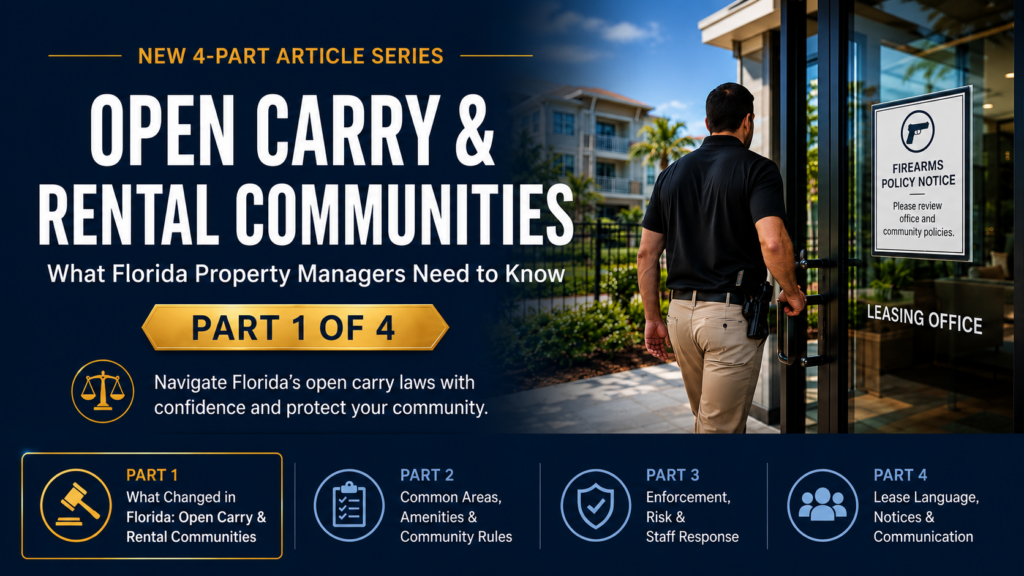
This article is the first in a four-part series from Property Management Law Solutions, PLLC examining Florida’s changing open carry landscape and what it may mean for landlords, property managers, rental communities, and community rules.
A resident walks into the leasing office with a holstered handgun visible at his side. Another resident complains. An employee asks whether to call law enforcement. The property manager looks to the lease and finds a broad “no weapons” clause written years ago.
What happens next?
That question became more complicated after Florida’s First District Court of Appeal struck down the state’s general prohibition against openly carrying firearms.
Visible possession of a firearm is no longer, by itself, enough to assume that someone is breaking the law. But that does not necessarily mean rental communities have lost the ability to establish rules for private property, shared amenities, employees, guests, or dangerous conduct.
It does mean those rules, and the way property staff enforce them, Fdeserve careful review.
For Florida property managers, this is not simply a constitutional-law debate. It is a practical issue involving lease enforcement, resident complaints, employee safety, signage, insurance, amenities, and how staff should respond when someone openly carries a firearm onto the property.
The immediate takeaway is simple: do not rush to post a sign, rewrite a policy, or confront a resident based on old assumptions.
First determine where the conduct occurred, what the lease and community rules actually say, who is involved, and whether the concern is lawful possession or dangerous behavior.
“Property managers can and should care about safety,” said Tim Baldwin, founder and lead attorney of Property Management Law Solutions, PLLC. “But the rule must be clear, enforceable, and tailored to the part of the property where the concern actually exists.”
What Changed?
In McDaniels v. State, Florida’s First District Court of Appeal struck down Florida’s longstanding prohibition against openly carrying firearms. The court relied on the Second Amendment framework established by the United States Supreme Court in New York State Rifle & Pistol Association v. Bruen.
For property managers, the practical change is significant: seeing a resident or guest openly carrying a firearm may no longer be enough, by itself, to assume that person is violating the law.
That creates uncertainty in rental communities, where public, private, and shared spaces often exist side by side. A public street is one thing. A tenant’s apartment is another. But what about a clubhouse, pool deck, fitness center, leasing office, dog park, parking lot, mail kiosk, laundry room, hallway, or community trail?
That is where the legal and operational questions become more complicated.
Apartment Communities Are Not Simple Public Spaces
Rental communities occupy a unique legal position. They are private property, and owners and managers generally have the right to establish rules governing shared spaces. Communities routinely regulate smoking, pets, noise, grills, parking, amenity use, guests, and other conduct that affects residents and staff.
At the same time, residents have rights within their leased homes. A rule that applies inside a resident’s private apartment may be viewed differently from one governing a clubhouse, fitness center, leasing office, or other common area.
That distinction matters. Property managers should avoid treating every part of the community the same when reviewing or enforcing firearms-related policies.
Common Areas Require Careful Review
Common areas are often where property managers have the strongest operational concerns.
Pools, fitness centers, clubhouses, parking areas, playgrounds, hallways, mail areas, and leasing offices are shared by residents, guests, employees, vendors, prospects, and children. Property managers have a legitimate interest in maintaining safety, reducing conflict, protecting employees, and preventing unnecessary escalation.
McDaniels addressed Florida’s criminal prohibition against open carry; it did not directly decide whether a private rental community may adopt or enforce its own firearms policy. Even so, a broad rule stating “no firearms anywhere on the property” may create legal and enforcement problems, especially if the policy is vague, overly broad, inconsistently applied, or not clearly incorporated into the lease or community rules.
Before adopting or enforcing a firearms policy, property managers should consider:
- Is the restriction limited to common areas?
- Does it apply to residents, guests, vendors, employees, or everyone on the property?
- Does the rule address lawful possession, open carry, threatening conduct, unsafe handling, brandishing, discharge, or all firearms-related conduct?
- Is the policy included in the lease, community rules, employee handbook, signage, or only followed as an informal practice?
- Was the policy disclosed before move-in?
- How should staff respond if someone refuses to comply?
- What should staff do when a person appears to be lawfully carrying but another resident complains?
The issue is not simply whether a community can adopt a firearms policy. The policy must also be clear, enforceable, legally defensible, and practical for staff to apply consistently.
Inside the Rental Unit Is Different
Property managers should be especially cautious when considering policies that regulate lawful firearm possession inside a resident’s private apartment.
A rental unit is not the same as a clubhouse, leasing office, or other common area. During the lease term, it is the resident’s home. Broad lease language attempting to prohibit lawful firearm possession inside the dwelling may therefore raise different legal concerns, particularly when the firearm is kept for self-defense.
That does not leave property managers powerless. Communities may still address threats, criminal activity, negligent discharge, unsafe handling, property damage, or other conduct that endangers residents, employees, or the property.
The important distinction is between regulating dangerous behavior and attempting to prohibit lawful possession altogether. For many communities, focusing on conduct rather than ownership may provide a clearer and more defensible approach.
Staff Response Matters
One of the greatest risks for property managers is not only the policy itself, but how staff respond when a firearm is visible.
If a resident or guest is openly carrying, staff should avoid assumptions and unnecessary confrontation. Open carry alone may no longer be enough to indicate criminal conduct. Threatening behavior, careless handling, brandishing, intoxication, trespass, violence, or refusal to follow lawful property rules may require a different response.
Staff should be trained to respond calmly, consistently, and based on the person’s conduct rather than the mere presence of a firearm. That may include documenting the incident, identifying the location, recording exactly what occurred, preserving available video footage, and contacting law enforcement when there is an immediate safety concern.
A resident walking through a parking lot with a holstered firearm presents a different situation from someone displaying a firearm during an argument. A firearm secured in a vehicle is different from one being handled in a crowded clubhouse. Those distinctions should be reflected in both the community’s policy language and its staff training.
Do Not Rely on Old Lease Language Without Review
Many existing leases and community rules were drafted before Florida’s open carry landscape changed. Some contain broad “no weapons” language. Others say nothing at all. Some communities may also rely on informal practices that are not clearly reflected in the lease or written policies.
Ambiguous language creates enforcement risk. A vague “no weapons” clause may lead to disputes over whether it applies to lawful firearms, whether it governs conduct inside a resident’s unit, whether it is limited to common areas, and what remedy the landlord may pursue for a violation.
Property managers should review their leases, rules, addenda, signage, and staff policies together. A firearms policy should not be drafted in isolation. It should fit within the community’s broader lease-enforcement structure, safety procedures, insurance requirements, and resident communication practices.
“The worst time to figure out your firearms policy is after someone walks into the leasing office or pool area carrying openly,” Baldwin said. “Communities should review the lease, community rules, signage, and staff response plan before there is a dispute.”
Practical Steps for Florida Property Managers
Before changing or enforcing firearms-related rules, property managers should consider the following steps:
- Review current lease language and community rules.
- Separate policies for private units from those governing common areas and amenities.
- Avoid vague or overly broad “no weapons anywhere” language without legal review.
- Focus policies on unsafe, threatening, unlawful, or disruptive conduct.
- Train staff to respond to visible firearms without escalating the situation.
- Coordinate firearms policies with insurance requirements and risk-management practices.
- Document incidents carefully and consistently.
- Follow proper notice and enforcement procedures when a lease or rule violation occurs.
- Seek legal guidance before adopting, revising, or enforcing firearms-related policies.
The Bottom Line
Florida’s open carry landscape has changed, but that does not mean every community rule is automatically invalid or automatically enforceable.
For property managers, the key is balance. Communities have legitimate safety concerns. Residents have legal rights. Common areas still require clear rules, lease language still matters, and staff need practical guidance on how to respond when firearm-related situations arise.
The worst approach is to react quickly with a broad policy that sounds simple but creates enforcement problems later.
The better approach is to review the lease, update community rules carefully, train staff, and make sure the policy is both legally defensible and practical to enforce.
This is the first article in our four-part series on open carry and Florida rental communities. In Part 2, we will examine one of the most important questions for property managers: whether apartment communities can restrict firearms in clubhouses, pools, fitness centers, leasing offices, parking areas, and other shared spaces.
Property Management Law Solutions, PLLC is a Florida law firm focused on helping property managers, landlords, and housing providers navigate the legal issues that arise in rental communities. PMLS represents hundreds of clients and communities across Florida and is built to make complex landlord-tenant issues easier to understand, faster to address, and more effective to resolve.
If your team has questions about lease enforcement, community rules, resident notices, amenity policies, or compliance concerns, PMLS can provide practical legal guidance before small issues become larger legal problems.
To schedule a consultation or speak with the PMLS team, call (850) 857-2463 or visit pmlawsolutions.com.