
By Tim Baldwin
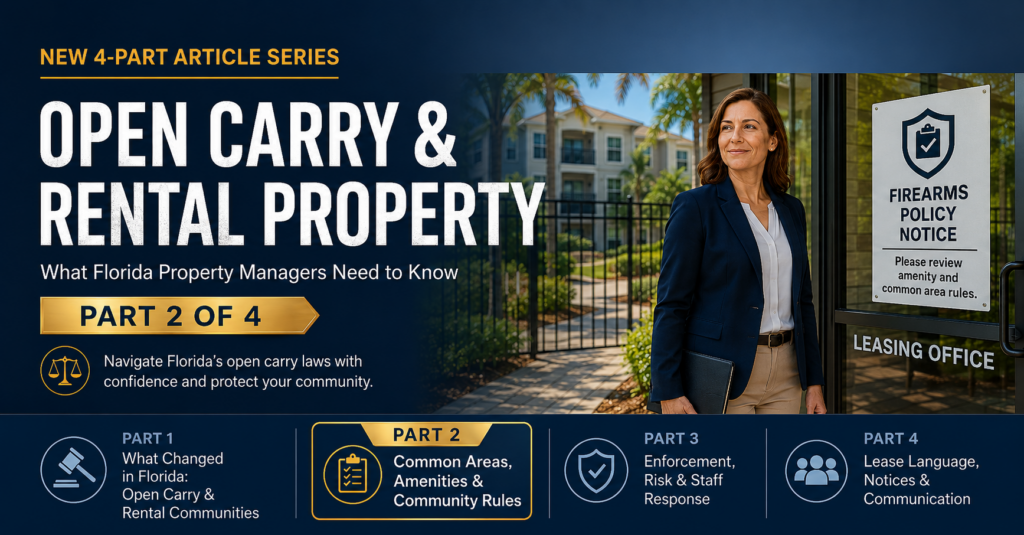
This article is the second in a four-part series from Property Management Law Solutions, PLLC examining Florida’s changing open carry landscape and what it may mean for landlords, property managers, and rental communities.
In Part 1, we looked at what changed and why property managers should be cautious before adopting or enforcing broad firearms restrictions.
Now we turn to the issue most likely to create day-to-day questions for apartment communities:
What can property managers do about firearms in common areas and amenities?
For many rental communities, this is where the issue becomes real. A resident lawfully possessing a firearm inside a private apartment presents different considerations than a resident or guest openly carrying near the pool, fitness center, leasing office, playground, clubhouse, mail kiosk, parking lot, or community event.
Common areas are shared spaces used by residents, guests, employees, vendors, prospective residents, children, and other visitors. Property managers have a responsibility to maintain order, reduce conflict, protect staff, and respond appropriately to safety concerns.
But as Florida’s open carry landscape changes, communities should proceed carefully. A rule that seems simple, such as “no firearms anywhere on the property,” may create more legal and practical problems than it solves.
“Common areas are where these policies are most likely to be tested,” said Tim Baldwin, founder and managing attorney of Property Management Law Solutions, PLLC. “The leasing office, pool, clubhouse, fitness center, and parking areas all present different risks. A good policy should recognize those differences instead of treating the entire property the same.”
Common Areas Require Different Analysis
The first step is to separate the community into different types of spaces.
A resident’s apartment is the resident’s home during the lease term. That creates privacy, possession, and self-defense considerations that may make broad firearm restrictions more difficult to enforce.
Hallways, pools, fitness centers, clubhouses, parking lots, laundry rooms, mail areas, leasing offices, business centers, dog parks, and recreational spaces are shared environments that are typically managed by the community. Property managers have a legitimate interest in establishing reasonable rules for how those spaces are used.
That does not mean every restriction will automatically be enforceable. But common-area policies often provide a more practical starting point than attempting to regulate lawful firearm possession inside a resident’s private dwelling.
Why Common Areas Create More Risk
Firearm-related incidents and policy questions in common areas can create several types of risk for property managers.
First, there is the immediate safety concern. A visible firearm in a crowded shared space may cause fear, confusion, or escalation, even when the person is otherwise carrying lawfully.
Second, there is staff safety and response. Leasing teams, maintenance employees, and managers should not be left guessing how to respond when a firearm is visible during a resident dispute, office visit, property tour, inspection, or amenity-related issue.
Third, there are resident-relations concerns. Some residents may feel unsafe when firearms are openly carried near pools, playgrounds, fitness centers, or clubhouses. Others may strongly object to rules that limit their ability to carry. Property managers can quickly find themselves caught in the middle.
Finally, there is liability. If a firearm-related incident occurs in a common area, questions may follow: Did the community have a policy? Was it clear? Was it consistently enforced? Did staff respond appropriately? Did management ignore previous complaints? Did the community create a rule it was not prepared to enforce?
That is why common-area policies need to be more than a sentence copied from an old lease form.
Avoid Vague “No Weapons” Rules
A vague “no weapons” rule may create more problems than it solves.
Does it apply only to firearms, or also to knives, pepper spray, tools, sporting equipment, or other items? Does it apply inside private apartments, or only in common areas? Does it apply to residents, guests, vendors, employees, prospective residents, or other visitors? Does it prohibit possession, open carry, unsafe handling, threatening display, discharge, threats, or all of the above?
If the rule is unclear, enforcement becomes more difficult.
A resident may argue that the rule does not apply to a lawfully possessed firearm. A guest may claim they had no notice of the policy. One manager may enforce the rule at the pool while another responds differently in the parking lot. A court may ask whether the rule was included in the lease, an addendum, a posted amenity rule, or merely followed as an informal office practice.
For firearms-related policies, clarity matters.
Property managers should avoid relying on generic language when the actual goal is to regulate specific conduct in specific spaces.
Think Space by Space
Not every common area presents the same concerns.
A leasing office is different from a parking lot. A fitness center is different from a hallway. A crowded pool deck on a summer weekend presents different considerations than a resident walking from a vehicle to an apartment.
Property managers should consider how a policy would apply in different areas of the community.
A leasing office may involve employee safety, prospective resident tours, rent discussions, complaint meetings, and emotionally charged conversations.
Pools and clubhouses often involve children, guests, alcohol, parties, and crowded recreational activity. Fitness centers present different concerns, including close contact and limited staff supervision.
Parking areas may involve late-night activity, towing disputes, resident confrontations, and interactions with law enforcement. Even hallways, elevators, laundry rooms, and mail areas can create challenges because residents and guests are moving through shared spaces at close range.
A well-drafted policy should account for these differences rather than treating every area of the property the same.
Regulating Conduct May Be More Defensible Than Regulating Possession
One of the most important distinctions is between lawful firearm possession and unsafe or threatening conduct.
A community may create greater legal risk by attempting to prohibit all firearm possession throughout the property, especially inside private units. Rules focused on conduct are often more practical, easier to apply consistently, and more defensible.
For example, a community may want to address:
- Unsafe handling or display of a firearm.
- Threatening conduct, intimidation, or the use of a firearm during a dispute.
- Discharge of a firearm.
- Leaving a firearm unattended in a common or amenity area.
- Failure to follow clearly communicated rules regarding how firearms must be carried or secured in shared spaces.
- Violations of legally reviewed and clearly communicated common-area or amenity rules.
- Conduct that creates a disturbance, nuisance, threat, or identifiable safety risk.
This approach keeps the focus on safety, conduct, and community operations rather than lawful ownership or possession itself.
“Property managers should be careful not to confuse firearm ownership with firearm-related conduct,” Baldwin said. “A policy focused on unsafe handling, threats, intimidation, discharge, or violations of clear common-area rules is very different from a broad attempt to regulate everything, everywhere.”
Rules Must Be Communicated Clearly
A firearms policy should not live only in the property manager’s head.
If a community intends to regulate firearms in common areas, the policy should be clearly stated in the appropriate documents. Depending on the community, that may include the lease, community rules, amenity rules, addenda, posted signage, employee procedures, or resident communications.
The timing also matters.
A rule disclosed before move-in generally provides clearer notice than a policy announced for the first time after a dispute. A signed addendum provides better documentation than a verbal instruction, and written amenity rules are more useful than inconsistent direction from different staff members.
Property managers should also be cautious about relying on signage alone. A sign can help communicate a policy, but it may not independently create a basis for lease enforcement. Signage, lease language, resident notice, and actual enforcement practices should work together.
Staff Should Not Be Left to Improvise
Even the best policy can fail if staff members do not know how to respond.
Property managers should have a practical response plan for firearm-related situations in common areas. Staff should understand when to document an incident, when to notify management, when to contact law enforcement, when to avoid confrontation, and when legal guidance is needed before issuing a notice or taking enforcement action.
The goal is not to turn leasing teams into legal analysts. It is to give them clear, calm, and usable direction.
Staff should recognize the difference between:
- A resident calmly walking through a parking area with a holstered firearm.
- A guest handling a firearm near the pool.
- A resident displaying a firearm during an argument.
- A firearm left unattended in an amenity area.
- A person refusing to leave the leasing office after being directed to do so.
- A threat made against staff, a resident, or another person.
These situations should not all be treated the same.
Consistency Is Critical
Inconsistent enforcement is one of the fastest ways to weaken a community rule.
If one resident is cited for openly carrying a firearm in a common area while another is ignored, the community may face claims of selective enforcement, retaliation, discrimination, or unfair treatment.
That does not mean every situation requires the same response. Facts matter. A holstered firearm is different from threatening conduct. A first-time misunderstanding of a posted rule is different from a repeated violation. An incident in a parking area is different from a confrontation inside the clubhouse.
But the decision-making process should remain consistent.
Staff should document what happened, where it occurred, who was involved, which rule applied, what notice had been provided, whether witnesses were present, and what action management took.
Practical Steps for Property Managers
Before adopting or enforcing a common-area firearms rule, property managers should consider the following:
- Review existing lease language, community rules, and amenity policies.
- Identify the specific common areas and amenities the policy is intended to cover.
- Distinguish private residential units from shared community spaces.
- Define whether the policy addresses possession, open carry, unsafe handling, threats, discharge, or other specific conduct.
- Avoid vague “no weapons” language without legal review.
- Align lease language, addenda, signage, amenity rules, and resident notice.
- Train staff to respond without escalating the situation and to document incidents carefully.
- Apply the policy consistently to residents, guests, vendors, and other users, as appropriate.
- Review applicable insurance requirements and risk-management concerns.
- Obtain legal guidance before issuing notices or pursuing enforcement.
The Bottom Line
Common areas are likely to be among the biggest pressure points in Florida’s evolving open carry landscape.
Property managers have legitimate reasons to establish reasonable rules for shared spaces. Pools, clubhouses, leasing offices, fitness centers, playgrounds, parking areas, and other common areas present different considerations than a resident’s private apartment. Communities need policies that protect residents, guests, employees, and day-to-day operations.
But firearms policies should be drafted carefully.
A broad rule may sound strong while creating legal risk. A vague rule may be difficult to enforce. An informal rule may not withstand a challenge. And a staff member improvising in the moment may unintentionally escalate the situation.
The better approach is to review existing lease language, clarify common-area rules, align signage and amenity policies, train staff, and document incidents consistently.
This is the second article in our four-part series on open carry and Florida rental communities. In Part 3, we will examine the difference between lawful open carry and threatening conduct, along with what property managers should document when firearm-related incidents occur.
Property Management Law Solutions, PLLC is a Florida law firm focused on helping property managers, landlords, and housing providers navigate the legal issues that arise in rental communities. PMLS represents hundreds of clients and communities across Florida and is built to make complex landlord-tenant issues easier to understand, faster to address, and more effective to resolve.
If your team has questions about lease enforcement, community rules, resident notices, amenity policies, or compliance concerns, PMLS can provide practical legal guidance before small issues become larger legal problems.
To schedule a consultation or speak with the PMLS team, call (850) 857-2463 or visit pmlawsolutions.com.